
Construction contracts include allowances that can help manage project budgets. Two of the most common are Provisional Sums (PS) and Prime Cost Sums (PC).
On paper, they look similar and for ease of reference are interchangeably referred to as “PC Sums” (rightly or wrongly).
Both are placeholders for scope and costs that aren’t locked in at contract signing (hence being referred to as ‘allowances’).
But confusing the two can head to arguments over who pays for what,and why the final contract costs has blown out.
We go through the difference between these two and why it matters.
A Provisional Cost Sum covers BOTH the supply of the materials and labour to install it.
It’s a best guess at the total cost of a defined but not fully detailed scope.
An example of a provisional sum is the removal of existing hazardous materials (hazmat). We know the hazmat needs to be removed but it’s difficult to know exactly how much of it there is.
Any profit, prelims and overheads are expected to be incorporatedinto the costs, so the price received for the works should only befor the trade costs (if the provisional sum allowance is not exceeded).
If the provisional sum does exceed the allowance, the Contractor canusually charge for preliminaries, overheads and margin at the rate stipulated in the contract. The contract stipulates whether margin can be charged on costs that exceed either each provisional sum or the aggregate allowance of all provisional sum allowances included in the contract.
A Prime Cost Sum, on the other hand, is an allowance for ONLY thesupply of an item. No labour. No install. Just the cost of the product itself.
It’s used when the Client hasn’t yet picked a final finish.
Common examples are:
When the choice is made, the placeholder rate or allowance is swapped out for the actual rate or cost + any builder’s margin and handling.
Since the install is not included, the install costs are usually expected to be incorporated into the contract costs. That makes defining install scope in the contract very important. For example,you should define that the tiles to be installed are marble (not porcelain) which attracts a higher install rate.
In summary:
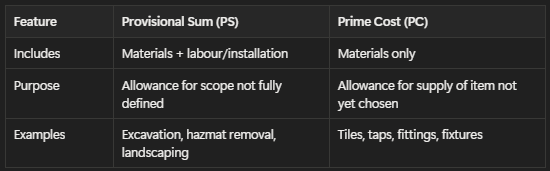
Both PS and PC allowances adjust once the real costs are known. That means:
The risk? If you don’t stay on top of these moving parts, costs creep. Disputes flare. And clients lose confidence in the numbers.
A great thing about PS and PC allowances is that amounts can be ‘let’ against them throughout the contract.
Let’s take the example of the hazmat allowance. The allowance maybe $50,000. As the Contractor completes the demolition works, they might find some asbestos behind a switchboard, more in the mastic ofmechanical ductwork and then more under some vinyl flooring. These separate transactions can be let against the PS allowance at different times.
The allowance is drawn down over the contract. The allowance isadjusted as amounts are let against it or when the the provisional sum is closed out.
Progress claims should only pay up to the maximum of committed let amounts (that is, the Superintendent or Contract Administrator has directed to removal to proceed).
Projx keeps both Project Managers and Quantity Surveyors working fromone place. Every allowance, let amount and adjustment is tracked on one platform, with the right context attached.
Projx allows client-side project teams to let amounts against allowances, open and close allowances and it automatically calculates the PFC, allowance adjustment and contract sum adjustment. There’s no other system that deals with provisional sum and prime cost allowances (just ask if you don’t believe us 😉).
These features means Clients see fewer surprises, teams waste less time reconciling numbers, and budgets stay grounded in reality.


© 2026 Copyright. All Rights Reserved.

