.jpg)
In construction, both Quantity Surveyors(QS) and Project Managers (PM) are pivotal. Their domains, while overlapping, serve distinct purposes. So, where does one role end and the other begin? Let’s break it down.
This article focuses on the roles ofquantity surveyors and project managers in Australia and New Zealand. The scopeof their role may differ in other countries.
A QS is the financial brain of the project. They specialise in all contractual and cost-related aspects - fromassisting with feasibility studies and cost planning to contractadministration, forecasting, and final cost reconciliation.
Key QS responsibilities include:
● Cost estimation, cost planning and cost management
● Preparing bills of quantities, tender documents, and contract terms
● Managing variations, progressclaims reviews, valuations, and disputes
● Lifecycle costing and financial reporting
● Preparing depreciation schedulesand finance reports
You won’t typically find a QS spending their time on project plans, preparing tender documents or doing defect reviews. That’s PM territory.
A PM is the project’s conductor. A PM is responsible for leading and coordinating the entire project, ensuring it delivers on scope, time, quality, and budget.
Typical PM tasks include:
● Developing schedules, resourceplans, and managing deadlines
● Coordinating stakeholders (clients, contractors, design teams)
● Leading risk management, quality control, and communication
● Often act as the Superintendent to administer the Head Contract
● Over seeing execution and facilitating project governance.
You won’t typically find a project manager preparing a cost plan or assessing a variation claim.
QS and PM don’t just work in parallel, they’re often the client’s closest advisors. Together, PM and QS form a kind of “dynamic duo”, each covering ground the other doesn’t and both indispensable to project success.
Clients share more with their project managers and quantity surveyors than with anyone else on the project.
Whether it’s through clear cost oversightor smooth delivery, the real value comes when clients trust they’re in steady hands - even when challenges arise.
In principle, quantity surveyors control costs. Project managers control everything else.
But in practice, their work constantly overlaps. QS insights shape PM decisions, and PM strategies influence QSactions. That interplay is what keeps projects on time, on budget, and on point. Some points of intersection are:
● Cost-related collaboration
○ QS provides cost estimates and forecasts that PMs use to build viable schedules and budgets
○ PMs rely on cost tracking and QS reports to monitor real-time financial health
● Contract and variation management
○ QS handles valuation of change orders, claims, and their financial impact
○ PM ensures that contract amendments are executed within the project’s timeline and overall objectives
A great example of where project managers and quantity surveyors need to work in sync is the head contract variation review process. Here’s what that looks like in practice:
● The Head Contractor advises of a potential variation. This may be captured as an anticipated cost in a cost report by the quantity surveyor.
● Later, the Head Contractor formally submits the variation to the Project Manager (acting as the Superintendent).
● The Project Manager /Superintendent confirms whether the variation is valid prior to having the Quantity Surveyor assess it.
● The Quantity Surveyor reviews the variation and provides their assessment / recommendation of costs to the Project Manager.
● The assessed amount is played back to the Head Contractor by the Project Manager who mediates the haggling and sometimes needs to provide a final determination of costs.
● The costs are then taken by the Project Manager to the Client for approval.
● If the costs are agreed, the final cost is tracked in the variation register by the Quantity Surveyor so it can be paid against when claimed.
The PM and QS need to get in each other’sfaces, line up responsibilities, talk often, and keep the whole thing inmotion.
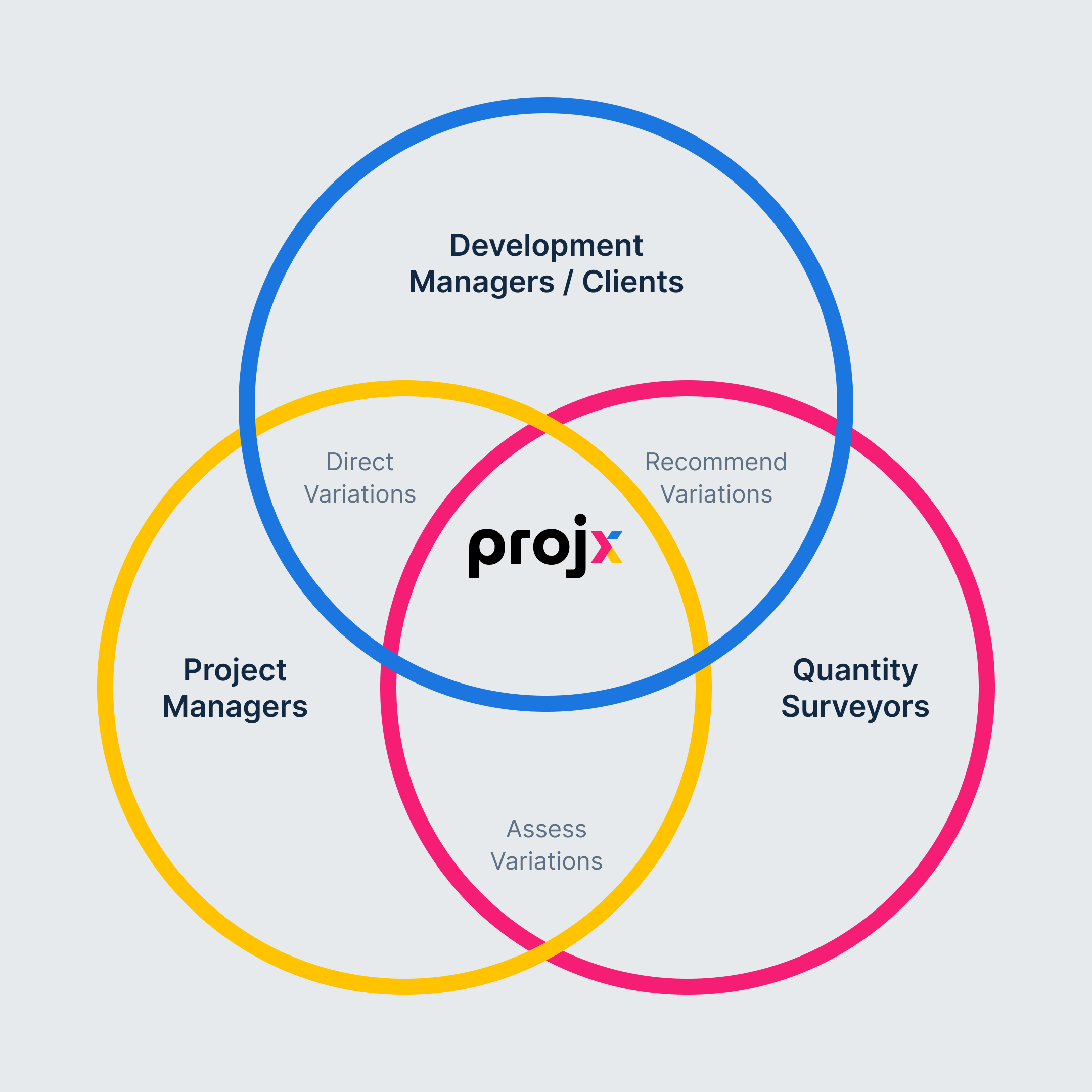
Given we are all working towards the samegoal - the Client - then why, for instance, are PMs and QSs still running separate head contract variation spreadsheets?
Multiple versions of the truth, scattered across different platforms, results in confusion.
And when PMs and QSs are out of sync, theClient usually feels it in misaligned numbers, conflicting reports and unreconciled costs.
The better way? Getting both partiesworking from the same page (literally).
Projx brings PM and QS teams onto one platform - unifying cost data, schedules, and communication.
For clients, that means fewer surprises, faster decisions, and confidence that their project is being managed as one coordinated effort.
Take the variation example: instead of chasing spreadsheets, emails, and attachments, imagine that everything - recommendations, approvals, and supporting info - lives in one place.
That’s what we’ve built - and it’s ready to use today. Check it out!


© 2026 Copyright. All Rights Reserved.

