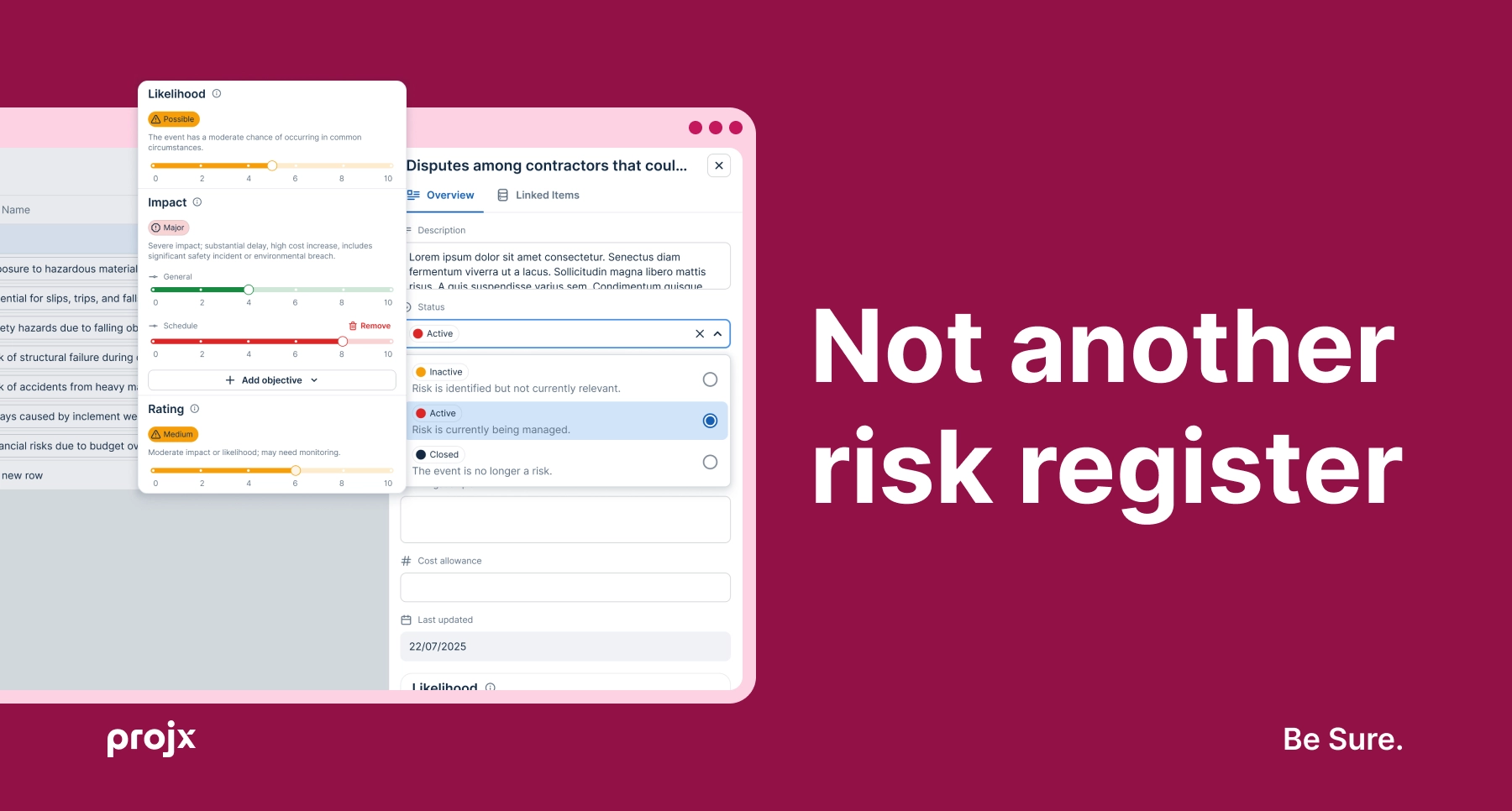
Risk registers are long, hard to set up and populate initially, andeven harder to keep updated. Hours of effort go unseen when a risk ismanaged well, but everyone gets upset when one slips through.
It’s no wonder registers often end up as static spreadsheets,updated once a month (if that), managed by one or two people chasingupdates across an entire project team.
The result? Outdated registers, blind spots, and risks that quietlysnowball until it’s too late.
With Projx’s new Risk Module, we’ve set out to changethat.
Risks don’t exist in isolation, and neither should the way we trackthem.
One of the biggest pieces of feedback we heard: “Risk can’tjust sit with one person.”
That’s a lot of weight on someone’s shoulders.
Risks are everyone’s issue.
So, we are creating a risk module which allows risks to be updated bythe whole project team, not just the PM or QS. Even a simple “nochange this month” counts as an update. That way, risks stay liveand visible, instead of locked away in someone’s spreadsheet.
Clients usually don’t want get into the detail of every risk.
They want to know the big ones:
That’s something Projx is trying to address by tracking riskmovement month to month, showing not just a static position butwhether things are improving or escalating - essentially, a risktrend.
Traditional risk ratings are blunt: likelihood × impact. But impactisn’t one-size-fits-all.
Our risk module will let you break it down by what really matters toyour project objectives:
So instead of calling a risk a vague “5/10,” you can see whetherit’s a 9/10 on financial impact but a 0/10 on program. We thinkit’s important to know this, so if our users want to get down tothis level of granularity, we are giving them the means to do that.
It also means users can view their project objectives and see howthey are tracking based on the type and level of risks associatedwith them.
Risks don’t float in isolation. They connect directly to issues,variations, EOTs, and adverse notices. If a risk eventuates,through Projx’s risk module, you’ll be able to see what actuallyhappened: the real cost, the real delay, the real lessons learned.
That turns the register into more than a compliance document. Itbecomes a real-time record of what went wrong (and right),essentially becoming your “lessons learnt” register - one you cancarry forward into your next project.
With Projx, we are aiming to transform risk management from being aonce-a-month chore to a shared, dynamic process that:


© 2026 Copyright. All Rights Reserved.

